Archive

News

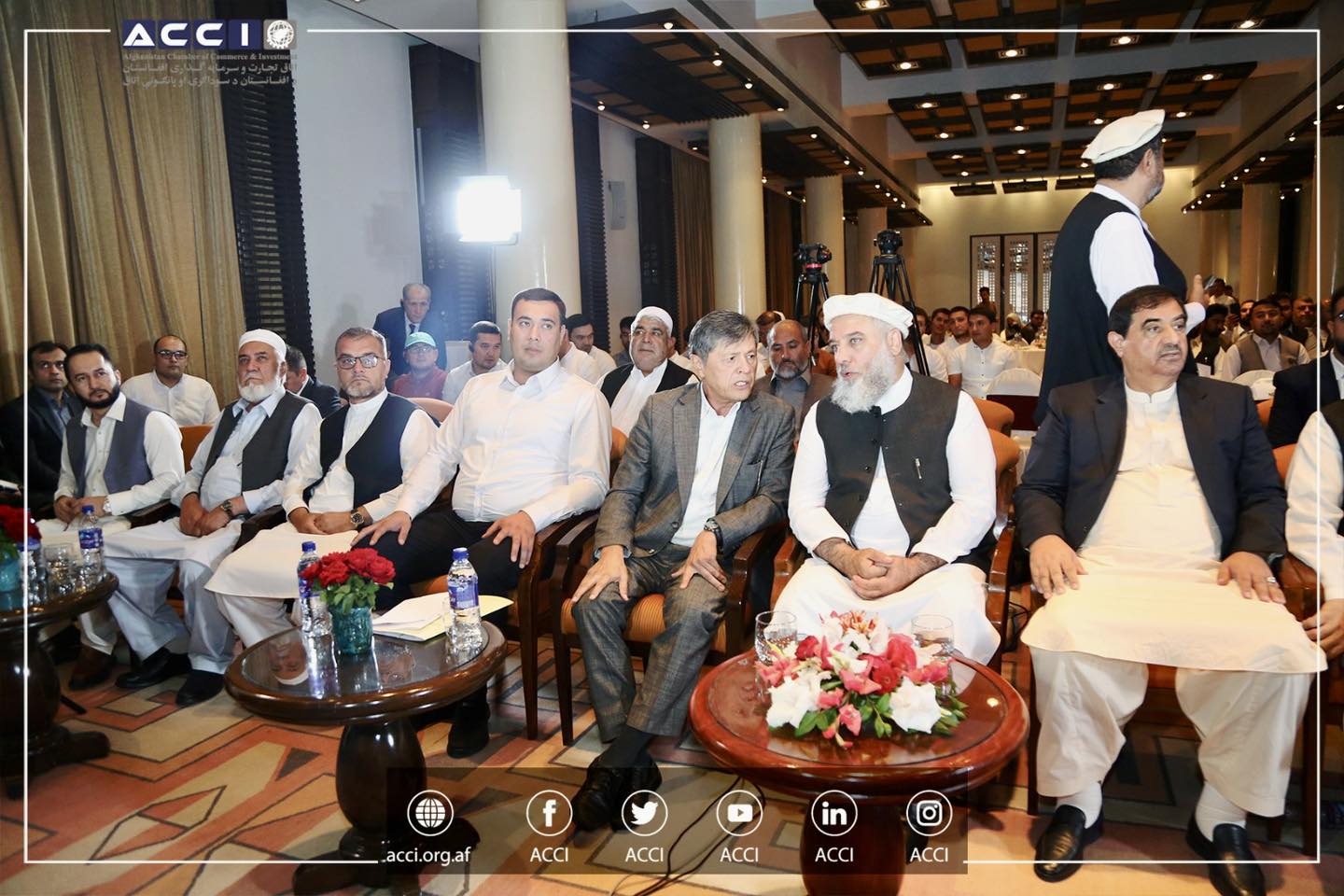
The Afghanistan Chamber of Commerce and Investment (ACCI), with the aim of expanding trade relations, exchanging ideas, and attracting investments to the country, held a meeting titled “Business Meeting of the Private Sectors of Afghanistan and Uzbekistan” at the Kabul Grand Hotel.


During the meeting, memorandums of understanding (MoUs) worth over 20 million USD were signed between traders and investors of the two countries in sectors such as healthcare, furniture, vegetables, oil and gas, logistics, cosmetics, construction, solar energy, and machinery.

Mr. Sayed Karim Hashimi, Chairman of ACCI, welcomed the guests and participants, describing Uzbekistan as a good friend with cultural commonalities and strong trade-economic ties with Afghanistan. He considered the visit of the Uzbekistan trade delegation to Afghanistan as important for the development of trade relations and the increase of joint investments between the two countries. He added that nationwide peace and security in Afghanistan have encouraged traders from neighboring and global countries to invest in various sectors of the country.


Mr. Hashimi stated that trade growth, increased investment in various sectors, facilitation for domestic and foreign investors by relevant government bodies, simplification of administrative procedures, the presence of both potential and actual investment capacities, vast natural and mineral resources, and the growing trade relations between Afghanistan and regional countries, especially Uzbekistan, reflect a new chapter in Afghanistan’s economic relations with the world. He also emphasized that facilitating the visa issuance process for Afghan traders is crucial in expanding bilateral trade relations, and requested the Ambassador of Uzbekistan to pay serious attention to this matter.


The Chairman of ACCI considered the signing of a trade MoU between Afghanistan and Uzbekistan—aimed at creating preferential tariffs on the export goods of both countries—an encouraging step, and assured ACCI’s full cooperation for the growth of trade between the two sides.

Mr. Nooruddin Azizi, Acting Minister of Industry and Commerce of Afghanistan, referred to his recent visit to Uzbekistan and described trade relations between the two countries as improving. He noted Afghanistan’s role as a transit hub linking South Asia with Central Asia, and called on all traders participating in the meeting to seize the opportunity and engage in joint investments in various economic sectors with Uzbek traders.

Mr. Mohammad Younus Mohmand, First Vice Chairman of ACCI, expressed his appreciation to the leadership of the Islamic Emirate and the Economic Deputy of the Prime Minister’s Office for their support of the private sector and for defining their foreign trade policies. He described the establishment of a regional joint chamber of commerce among Afghanistan, Uzbekistan, Kazakhstan, Azerbaijan, Turkmenistan, and Türkiye as important for increasing the export volume of Afghan products to global markets, resolving private sector problems promptly, and creating transit facilities among the mentioned countries.

Mr. Mohmand described Afghanistan as a transit hub for Asian countries and encouraged Uzbek traders to transport their goods through Afghanistan to South Asian countries. He also regarded the current opportunities in Afghanistan as a favorable ground for investments, urging Uzbek traders to invest jointly with Afghan traders in various Afghan sectors.

Mr. Ebek Usmanov thanked ACCI for organizing the meeting, calling such gatherings important for developing trade relations between the two countries. He considered Afghanistan’s nationwide security vital for economic, industrial, and trade growth, and assured full cooperation with ACCI in resolving the problems of Afghan traders.

Mr. Tashmatov, Head of Exports at the Uzbekistan Chamber of Commerce, referred to the increase in trade between Afghanistan and Uzbekistan over the past year and described the role of such meetings as valuable for developing bilateral trade. He stated that the main purpose of their visit to Afghanistan was to pursue joint investments with Afghan traders and find practical solutions for addressing the problems of the private sectors of both countries.

In addition to the above-mentioned speakers, the meeting was attended by ACCI leadership members, the Uzbekistan trade delegation, and a large number of traders and investors from both countries.


Sunday, 12 Asad 1404
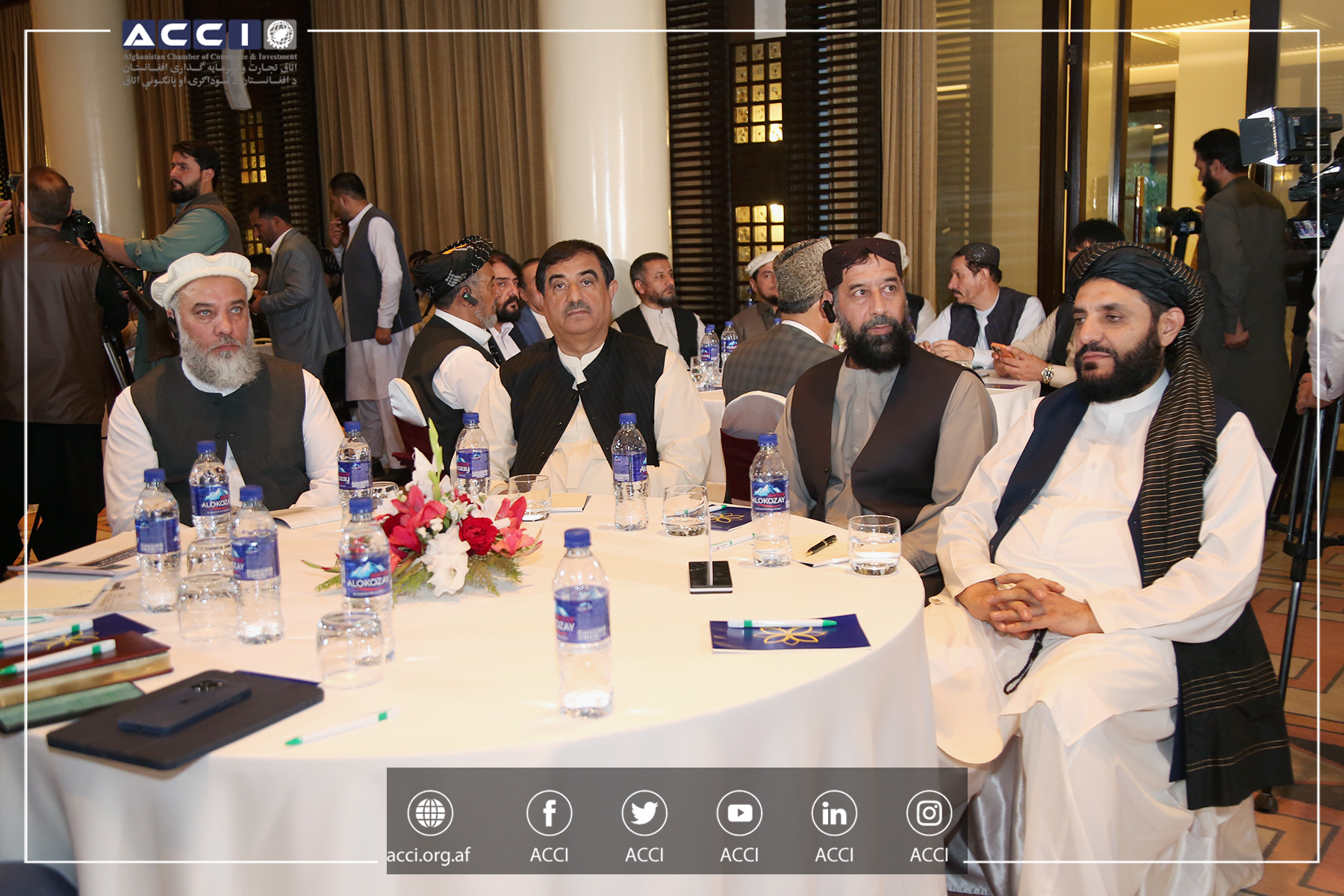
 

The Afghanistan Chamber of Commerce and Investment (ACCI), with the aim of attracting investments, exchanging business ideas, expanding trade, and boosting the country’s exports, held a Business-to-Business (B2B) meeting between the private sectors of Afghanistan and Tatarstan at the Kabul Grand Hotel.

During this meeting, agreements worth more than 185 million USD were signed between Afghan and Tatarstan traders in sectors such as construction, petroleum products, energy production, food items, clothing, pharmaceuticals, transportation, detergents, furniture, electrical appliances, and agricultural machinery.

Mr. Sayed Karim Hashimi, Chairman of the Afghanistan Chamber of Commerce and Investment, while welcoming the honorable Tatarstan trade delegation and the participants of the meeting, described such gatherings as important for joint investments and the development of trade relations between the two sides. He expressed his appreciation to both the Tatarstan and Afghan sectoral delegations for their participation. He said that the main objective of today’s meeting was to work toward trade agreements between the private sectors of the two sides, urging all participating traders to make the most of the opportunity and sign further agreements in various sectors.

Mr. Hashimi considered the overall security in the country as a favorable foundation for investment in different sectors of Afghanistan. He called on all Afghan private sector members residing abroad to return home and invest—just as other traders, such as the Azizi Group, have done by investing 10 billion USD in the energy production sector—thus creating jobs for their fellow citizens. He assured ACCI’s full cooperation in improving Afghanistan’s trade relations with regional and global countries, especially Tatarstan, and called on the Deputy Prime Minister of the Republic of Tatarstan to increase their petroleum exports in accordance with Afghanistan’s norms and standards.

Mr. Krook Chinko Alvik Vladimirovich, Deputy Prime Minister and Minister of Industry and Trade of the Republic of Tatarstan, presented information on his country’s economic achievements and products, emphasizing the development of trade and investment between the two sides. He expressed hope that many memorandums of understanding would be signed between the private sectors of the two sides during the meeting.

Mr. Nooruddin Azizi, Acting Minister of Industry and Commerce of Afghanistan, described the meeting as a valuable opportunity for investment and trade development between the two sides and called on traders and investors to take advantage of the opportunity to sign strong trade agreements.

Mr. Azizi referred to Afghanistan’s private sector as the most active in the region and considered its role vital in the country’s economic growth. He also announced that the banking problem of Afghan traders in Tatarstan, Russia, would be resolved in the near future.

Mr. Mohammad Younus Mohmand, First Vice Chairman of ACCI, emphasized the importance of trade and investment between Afghanistan and Tatarstan, and said that, as a first step, establishing a branch of an Afghan bank in the Republic of Tatarstan would be important in boosting bilateral trade. He also noted the role of air cargo services in increasing Afghanistan’s exports to regional countries, especially India, and called for Tatarstan’s cooperation in this regard.


Mr. Mohmand highlighted Tatarstan’s expertise in poultry farms and called for joint investments with Afghan traders in this field. He also urged for more facilitation in issuing visas for Afghan traders, particularly in coordination with the Afghan Ministry of Industry and Commerce.

In addition to the above-mentioned speakers, the meeting was attended by ACCI board members, the Tatarstan trade delegation, and a large number of traders and members of the private sector from both sides.


Thursday, 16 Asad 1404

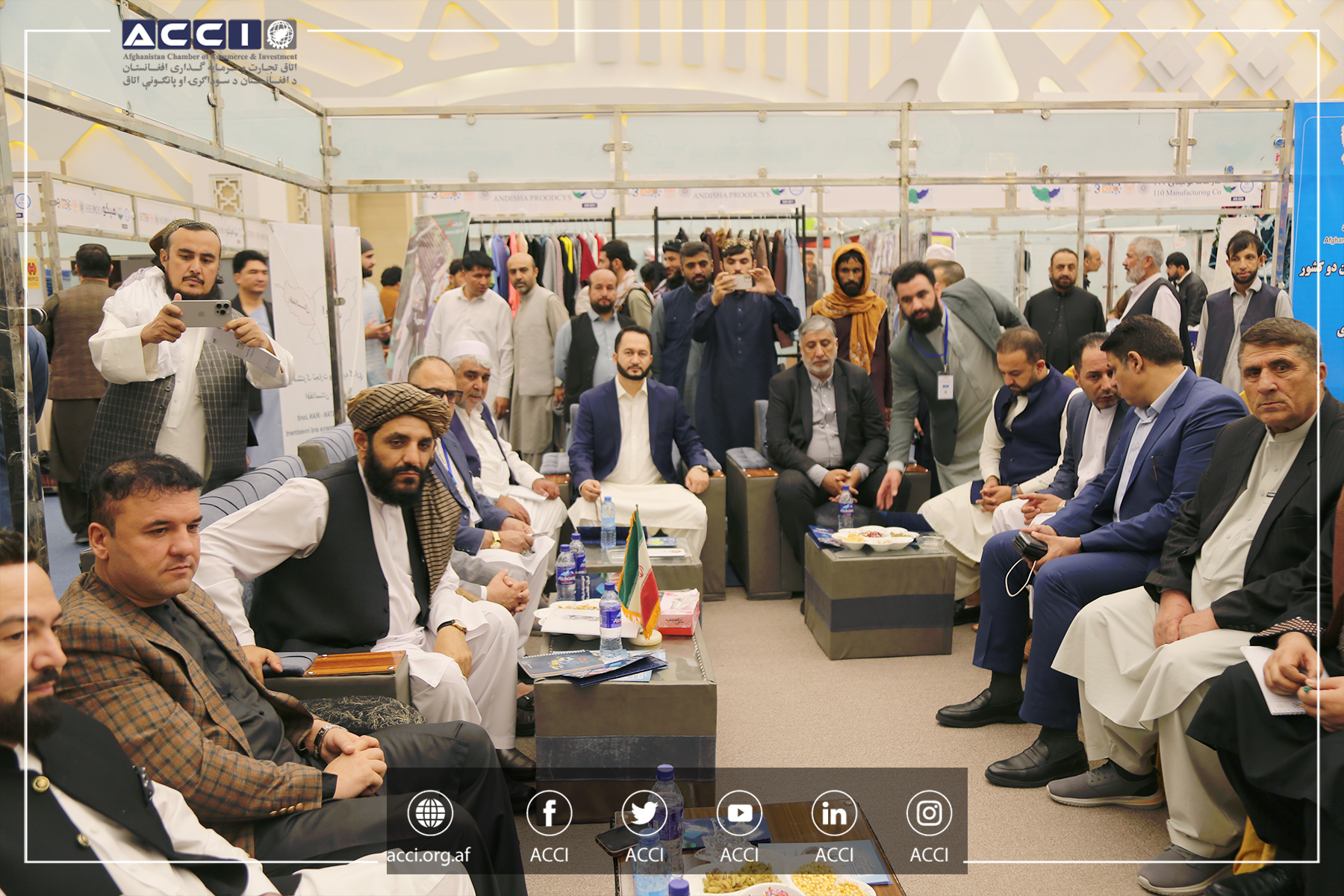
 The leadership of the Afghanistan Chamber of Commerce and Investment (ACCI), including Mr. Tawakal Ahmadyar, Chairman of ACCI; Mr. Mohammad Younus Mohmand, First Vice Chairman; Mr. Sayed Javid Burhan, Head of International Relations; Mr. Sultan Mohammad Safi, Mr. Khanjan Alokozay, Mr. Sayed Parwiz Sadat Hufyani, and Mr. Ahmad Shekib  Ahmadyar, board members, along with Mr. Sayed Jamil Sadat, Head of the Kabul Chamber of Commerce; Mr. Ahmad Shah Hakimi, First Vice Chairman of the Kabul Chamber; Mr. Mirza Aman Popal, Acting Deputy of Finance and Administration; and Mr. Zalghai Azimi, Head of Azimi Group of Companies and BKB, visited the Iranian product booths. They held discussions with Mr. Syadat, Head of the Iran-Afghanistan Chamber of Commerce; Mr. Nourizadeh, Deputy Economic Governor of Razavi Khorasan Province; and their team on expanding trade relations between the two countries.


Mr. Tawakal Ahmadyar welcomed Mr. Syadat, Mr. Nourizadeh, and their team to Afghanistan, shared information on the country’s current opportunities, and requested Mr. Syadat to encourage Iranian investors to invest in various sectors in Afghanistan, especially in the mining sector.


Mr. Mohammad Younus Mohmand emphasized the importance of expanding economic and trade relations while safeguarding the national interests of both countries. He suggested forming a joint working committee to identify and address the challenges faced by traders from both sides and shared Afghan traders’ issues with Mr. Syadat, requesting solutions.


Mr. Sayed Javid Burhan highlighted Iran as a good friend with shared religious and cultural ties, as well as economic and trade relations with Afghanistan. He emphasized the significant role of the joint chamber in strengthening exchanges between the two nations.


Mr. Syadat assured his cooperation in encouraging Iranian traders to invest in various sectors in Afghanistan and emphasized the importance of expanding the activities of the joint chamber in both countries.


Monday, 16th of Mezan, 1403


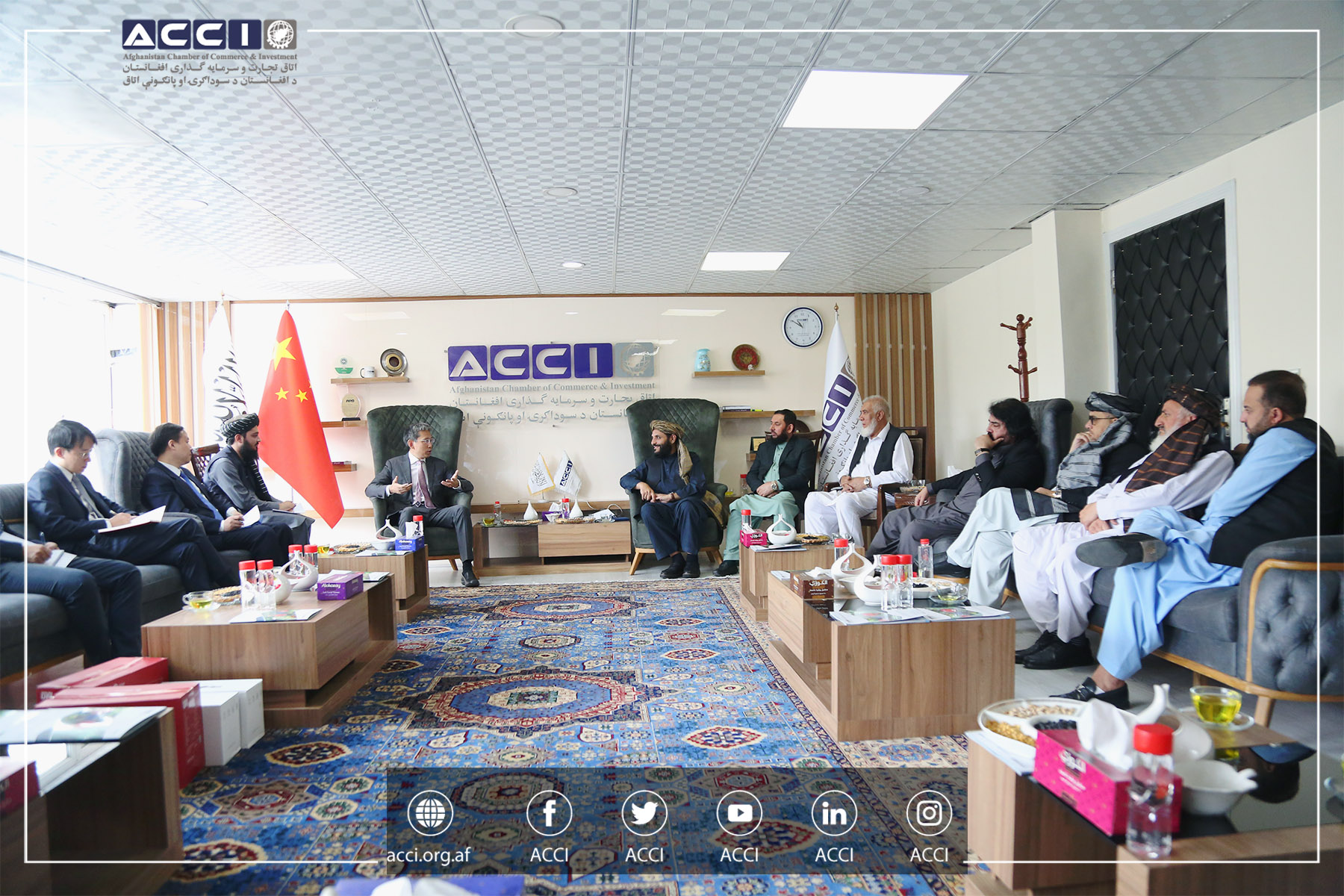
The leadership of the Afghanistan Chamber of Commerce and Investment (ACCI), including Mr. Mohammad Younus Mohmand, First Vice Chairman of ACCI; Mr. Khairuddin Mayel Ahmadi, deputy commercial of ACCI; Mr. Shirin Agha Sakhi, Head of Finance; Mr. Sayed Javid Burhan, Head of International Relations; Mr. Khanjan Alokozay, Mr. Sultan Mohammad Safi, Mr. Sayed Parwiz Sadat Hufyani, and Mr. Ahmad Shikeb Ahmadyar, board members, along with Mr. Ahmad Shah Hakimi, First Vice Chairman of the Kabul Chamber of Commerce; Mr. Mirza Aman Popal, Acting Deputy of Finance and Administration; Mr. Tawakal Khorram, Head of ACCI’s Dispute Resolution Center; and Mr. Abdul Mateen Ghalib, Head of ACCI’s International Department, met with Mr. Zhao Zheng, the Ambassador of China to Afghanistan, and his team at ACCI headquarters discussed the expansion of trade and economic relations between the two countries.

Mr. Mohammad Younus Mohmand warmly welcomed Mr. Zhao Zheng and his team, expressing gratitude for China’s financial and comprehensive support to the people of Afghanistan over the years and for their contributions to large infrastructure projects in Afghanistan. He provided insights into ACCI’s activities, especially the leadership’s participation in trade conferences and meetings in China.

The First Vice Chairman of ACCI described China as one of the world’s most modern and technologically advanced countries, emphasizing the importance of strengthening economic and trade relations. He requested China’s cooperation in organizing a joint exhibition and establishing a trade market where all domestic products from both countries could be showcased and sold.

Mr. Mohmand highlighted the Wakhan Corridor as a direct transit link between China and Afghanistan, noting its potential to expedite trade and foster economic and political relations between the two countries. He urged Mr. Zhao Zheng to coordinate with the Chinese government to prioritize the reconstruction of this route.

Mr. Khairuddin Mayel Ahmadi regarded such meetings as a crucial step in enhancing trade and solidifying relations between the two countries. He pointed out that many Afghan production factories rely on raw materials imported from China and requested Mr. Zhao Zheng to facilitate easier access for importing Chinese machinery.

Mr. Khanjan Alokozay discussed trade issues between Afghanistan and Pakistan and requested that the Chinese Embassy assist in resolving the existing trade challenges with Pakistan.

Mr. Mirza Aman Popal shared information about the export of Afghan pine nuts to China, emphasizing the need for subsidies from the Chinese government to support Afghan traders. He noted that China’s restrictions on the import of certain Afghan agricultural products are a significant challenge for Afghan traders and requested Mr. Zhao Zheng’s support in signing an agreement with the Ministry of Agriculture to facilitate the export of agricultural goods.

Mr. Zhao Zheng thanked the ACCI leadership for organizing the meeting and mentioned recent developments in lifting bans on Afghan exports to China. He announced that Afghanistan can now export its pomegranates to China and expressed his commitment to working on removing restrictions on other agricultural products as well. He also promised cooperation in coordinating with the Chinese government to restore the Wakhan Corridor and to address Afghan traders’ issues at Karachi port.


Tuesday, 17th of Mezan, 1403


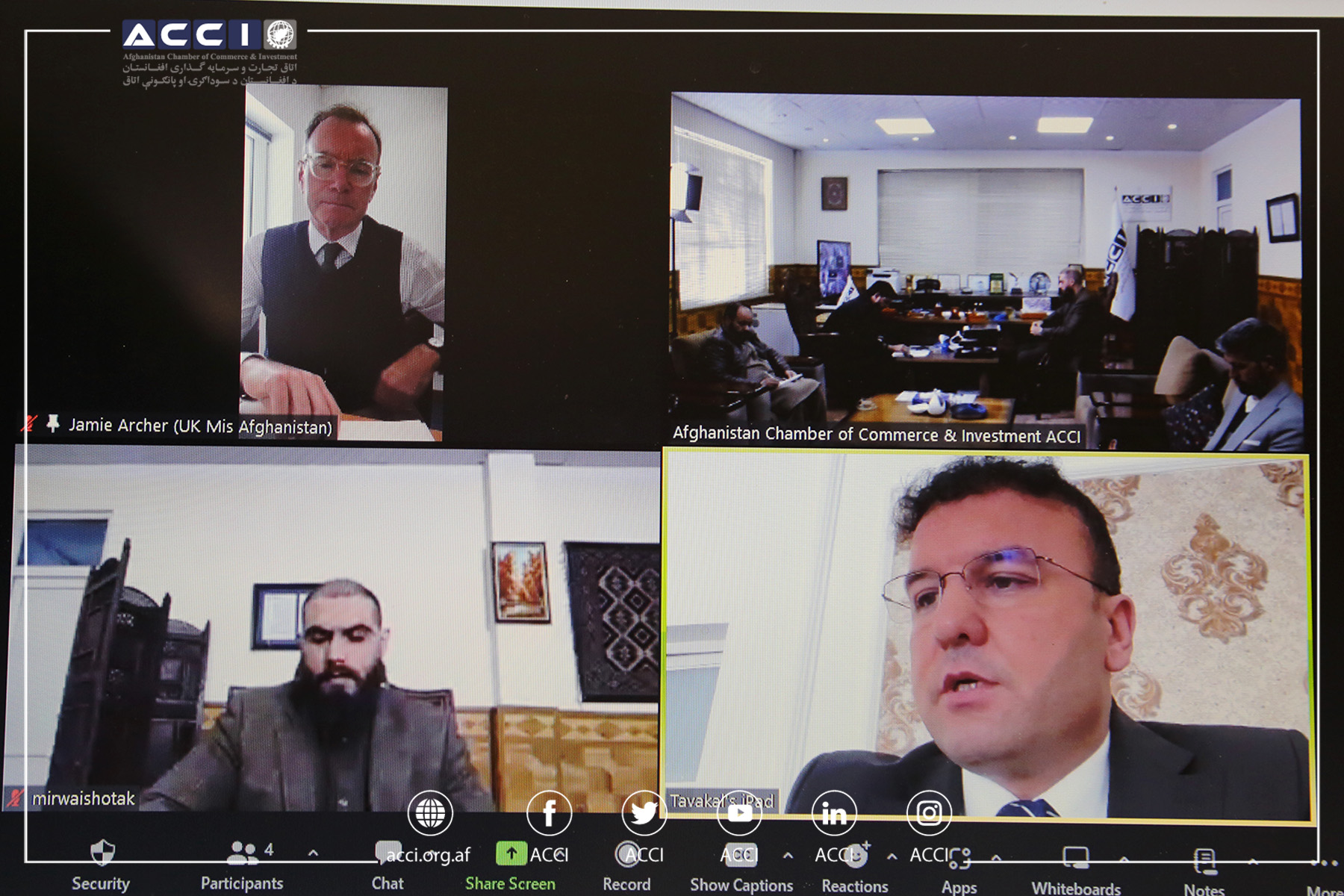
ACCI’s Chairman Mr. Tawakal Ahmadyar, in the presence of ACCI’s acting CEO Mr. Mirwais Hotak, head of International Relations of the ACCI, and head of the Public Relations, holds an online meeting with the British Chargé d'Affaires to Afghanistan Mr. Robert Chatterton Dickson and discusses the challenges that the Afghan Private Sector is facing and the current economic situation of Afghanistan.

Mr. Ahmadyar said, “Challenges in banking and finance sectors, visas not being issued for Afghan traders by some countries, lack of financial support, lack of the interest of the donors to execute the commercial and economic plans of the Afghan Private Sector, and international community and global banks not completing their incomplete projects are challenges that have weakened the Afghan Private Sector and eliminated employment opportunities.”

He also added that to solve these problems, they have had many meetings with governmental authorities and will continue to do so. Meanwhile, they urge the international community to increase its support of the Afghan Private Sector.

Additionally, elaborating on the existing trade and transit problems with Pakistan, Mr. Ahmadyar said, “Officials in Karachi Port have increased insurance on Afghan commercial commodities, banned 212 imported items, and detained hundreds of containers which leads to the disastrous loss of the Afghan traders and investors.”

“Blemished economic and trade relations with the international community and countries of the region have caused numerous concerns among the Afghan Private Sector, but strengthening them will enable us to normally continue our export and import processes,” said Mirwais Hotak.

Mr. Dickson, besides appreciating the meeting and declaring it as imperative, said that he had had many trips to Afghanistan but in this meeting, many crucial and essential issues were brought up that need to be addressed as soon as possible.

He, furthermore, underscored the inclusion of women in economic and trade initiatives and requested ACCI’s Chairman to facilitate effective communications in this regard.

In conclusion, Mr. Dickson extended a formal invitation to Mr. Tawakal Ahmadyar to participate in the upcoming gathering organized in Doha and represent the Afghan Private Sector.


February 5th, 2024

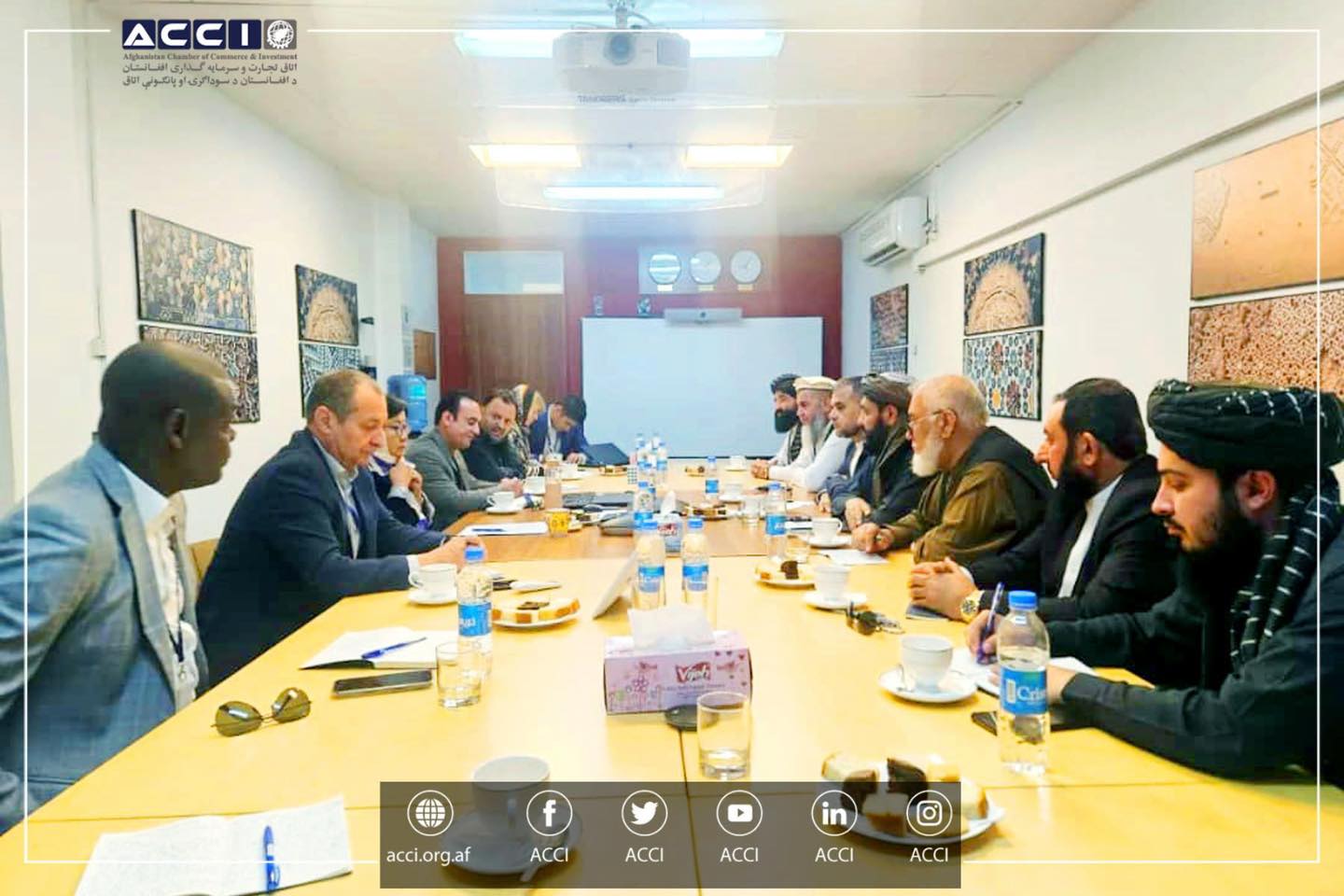
The leadership of the Afghanistan Chamber of Commerce and Investment (ACCI), including Mr. Mohammad Younus Mohmand, First Vice Chairman of ACCI; Mr. Khairuddin Mayel Ahmadi, Deputy Commercial of ACCI; Mr. Sultan Mohammad Safi, and Mr. Khanjan Alokozay, members of the ACCI Board, along with Mr. Gul Murad Arab, President of the Southeastern Provinces Fruit and Vegetables Union, and Mr. Sardar Wali Pashtun, President of the Pine Nut Union, met with Ms. Rosa Otunbayeva, the Head of UNAMA in Afghanistan, at UNAMA’s headquarters. Ms. Dinay Boggs, UNAMA’s Economic Advisor; Mr. Dmitry, UNAMA Office Head; and Mr. Abubakr, UNAMA’s Technical Officer, were also present from the UNAMA side.

Ms. Otunbayeva welcomed the ACCI leadership delegation to UNAMA headquarters and commended the success of the third round of the Imam Abu Hanifa National and International Exhibition. She described the exhibition as a significant achievement for Afghanistan’s private sector, expressing satisfaction with the active participation of men, women, and school students, and emphasized UNAMA’s commitment to ensuring the exhibition’s international recognition by coordinating with visiting organizations.

Ms. Otunbayeva highlighted the important role of the private sector in Afghanistan's economic growth and humanitarian support and mentioned the formation of a working group in Doha to support Afghanistan’s private sector. She assured that UNAMA, in cooperation with ACCI, is working to address issues related to banking and other challenges faced by the private sector through this working group.

Mr. Mohammad Younus Mohmand expressed appreciation to Ms. Otunbayeva for providing an opportunity to hear about the private sector’s issues and emphasized Afghanistan’s commitment to maintaining positive economic and trade relations with the world. He shared details about the audio message from the Office of the Prime Minister during the closing ceremony of the third Imam Abu Hanifa National and International Exhibition, which was aimed at supporting the private sector and ACCI, and called for friendly economic relations between Afghanistan and the world while safeguarding national interests.

Mr. Mohmand explained that Afghanistan’s banking issues are leading to the conversion of legal money into informal channels, which significantly impacts the country’s private sector. He welcomed the establishment of the Doha working group to find solutions to Afghan traders' problems and stressed the importance of highlighting the ACCI’s role in this group. The First Vice Chairman of ACCI also praised Afghanistan’s achievements in eradicating poppy cultivation, ensuring nationwide security, and reducing administrative corruption over the past three years and urged the United Nations to support farmers with alternative crop options.

Mr. Khanjan Alokozay described UNAMA’s office as a common home for people around the world and Afghanistan and assured of ACCI’s efforts in controlling the prices of essential goods and other necessities in Afghanistan.

Mr. Alokozay addressed key issues Afghan traders face, including non-payment by international organizations for completed projects, lack of visa issuance by certain countries for Afghan traders, closure of borders, and increased tariffs on certain Afghan exports, especially agricultural products, by Pakistan. He requested Ms. Otunbayeva’s cooperation in these matters.

Mr. Khairuddin Mayel Ahmadi provided information on the activities of the private sector despite existing challenges and requested that Ms. Otunbayeva facilitate greater visa support in cooperation with European and Asian countries to enable Afghan traders to increase exports of Afghanistan’s dried fruits to these markets, particularly India.

Mr. Sultan Mohammad Safi noted that Afghanistan has overcome numerous challenges, and in this critical period, further support and cooperation from international organizations for Afghanistan’s private sector are essential.

At the end, Mr. Abubakr, the UNAMA Technical Representative, provided an explanation about the activities of the Doha working group, which will focus on four main areas: job creation by the private sector, providing financial assistance to entrepreneurs, establishing connections between the private sector and international markets, and collaborating with local authorities for Afghanistan’s trade development.

Finally, Ms. Rosa Otunbayeva affirmed UNAMA’s full support for the proposals presented by the ACCI leadership, adding that she would discuss visa facilitation for Afghan traders with the authorities in India. She also encouraged the ACCI leadership to engage with international organizations, particularly SAARC, ECO, and other Islamic countries, to help


Monday, 23rd of Mezan, 1403 / 11th of Rabi' al-Thani, 1444 / October 14, 2024

More Articles ...