Wednesday, September 16, 2026
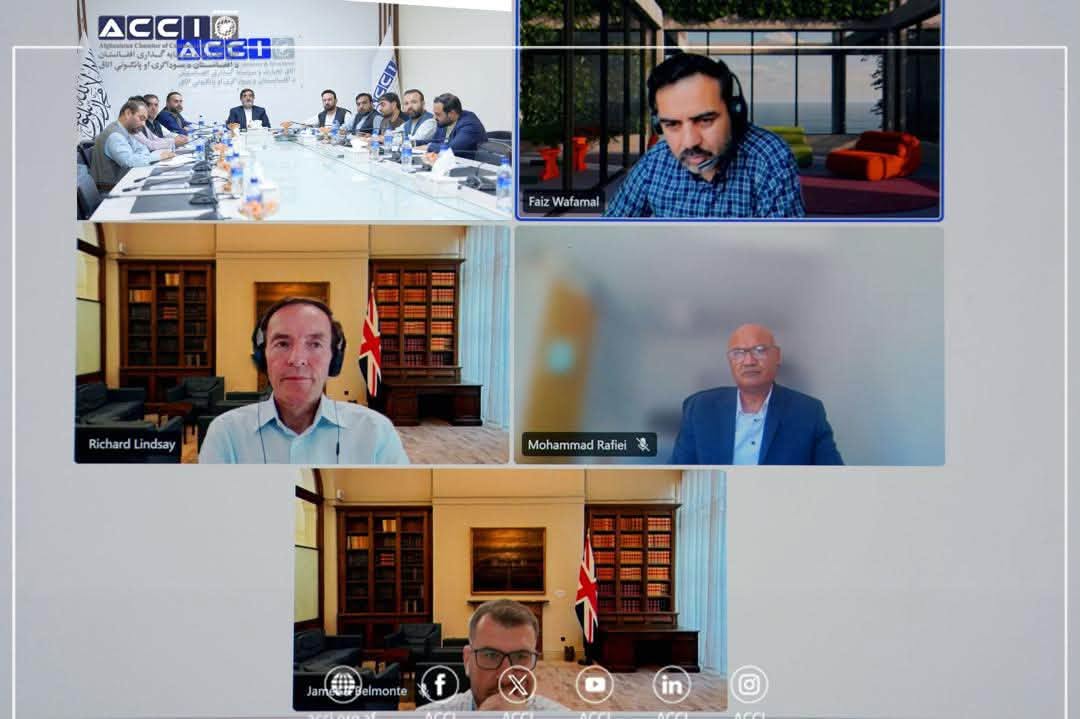
Mr. Sayed Karim Hashemi, Chairman of the Afghanistan Chamber of Commerce and Investment (ACCI), held an online meeting on Tuesday evening with Mr. Richard Lindsay, the United Kingdom’s Special Representative for Afghanistan. A number of ACCI deputies and members of the Board of Directors also attended the meeting.
Mr. James Belmonte; Mr. Alastair Burnett, Head of the Development Department at the Foreign, Commonwealth and Development Office (FCDO); Mr. Jack Peters, Humanitarian Affairs Adviser; and Mr. Faiz Wafamal, Political Adviser at the UK Foreign Office, also participated in the meeting.
The meeting focused on the situation of Afghanistan’s private sector, opportunities and challenges in trade and investment, banking and financial difficulties, regional developments, transit routes, and ways to expand Afghanistan’s trade relations with regional and international countries.
During the meeting, the UK Special Representative raised questions regarding the current state of Afghanistan’s trade and the impact of the closure of certain trade routes with Pakistan, regional developments and conflicts, and banking and transit challenges on Afghanistan’s markets.
In response, Mr. Sayed Karim Hashemi stated that, despite difficult circumstances and successive regional crises, Afghanistan’s private sector has managed to maintain trade flows and meet the basic needs of the country’s markets through efforts, innovation, and effective management.
He emphasized that the leadership of the Afghanistan Chamber of Commerce and Investment, members of the Board of Directors, traders, industrialists, and investors across the country, as a hardworking, determined, and people-oriented sector, have assumed an important responsibility in maintaining market stability and meeting the needs of the people under difficult conditions.
The Chairman of ACCI added that, following the imposition of restrictions and the closure of certain trade routes, the private sector, in cooperation with relevant government institutions, had adopted new measures and activated alternative routes and sources to prevent disruptions in the supply chain.
He stated that Afghan traders had expanded imports from India through Chabahar Port and Bandar Abbas to meet the country’s needs for medicines, essential materials, and other basic necessities. Following the outbreak of war and insecurity in Iran and the resulting risks to these routes, the private sector once again acted swiftly and increased the use of alternative routes through Central Asian countries, including Uzbekistan, Kyrgyzstan, Tajikistan, and Kazakhstan, as well as China.
Mr. Hashemi noted that, in this way, the private sector was able to manage another crisis and prevent serious shortages in Afghanistan’s markets. He added that, despite regional pressures on the supply chain, essential goods had been supplied through various routes, allowing Afghanistan’s markets to continue their normal activities.
The Chairman of ACCI also referred to challenges in the petroleum sector and stated that the Russia–Ukraine war, recent regional developments, and the vulnerability of oil facilities and refineries had created difficulties and pressure in the region’s energy market.
He added that, despite these circumstances, the supply and storage of petroleum products in Afghanistan had been managed through the initiative of the private sector and in coordination with the public sector. He noted that the required materials had remained available in fuel tanks and petroleum storage facilities across the country.
Mr. Hashemi clarified that price increases may occur amid regional and global crises; however, the key point is that Afghanistan has not faced any serious shortage or major interruption in the supply of fuel, petrol, diesel, and gas. Citizens, drivers, and transport-sector workers have been able to meet their needs from supply centers in different parts of the country.
He described this situation as the result of the efforts of traders and investors, the leadership and coordination of the Afghanistan Chamber of Commerce and Investment, and the cooperation of relevant government institutions. He emphasized that the experience of several recent crises had demonstrated the capacity and resilience of Afghanistan’s private sector in managing difficult circumstances and maintaining market stability.
During the discussion, the British side also expressed interest in how these challenges had been managed and how the flow of goods had been maintained in Afghanistan, given the scale of regional difficulties. In response, the Chairman of ACCI emphasized that, through joint efforts by the private sector and cooperation with government institutions, widespread shortages in the market had so far been prevented.
In another part of the meeting, the participants exchanged views on expanding Afghanistan’s trade relations with the United Kingdom, Italy, and other European countries, as well as increasing travel and direct communication among traders.
The chambers of commerce, traders, investors, and British companies were also invited to participate in the Imam Abu Hanifa (RA) National and International Exhibition, scheduled to be held in Kabul on 3rd of October, and to become familiar with Afghanistan’s products, capacities, and trade and investment opportunities.
At the conclusion, both sides emphasized the importance of continuing dialogue, increasing engagement between the Afghan and British business communities, and strengthening economic, trade, and investment cooperation.